
CAC News
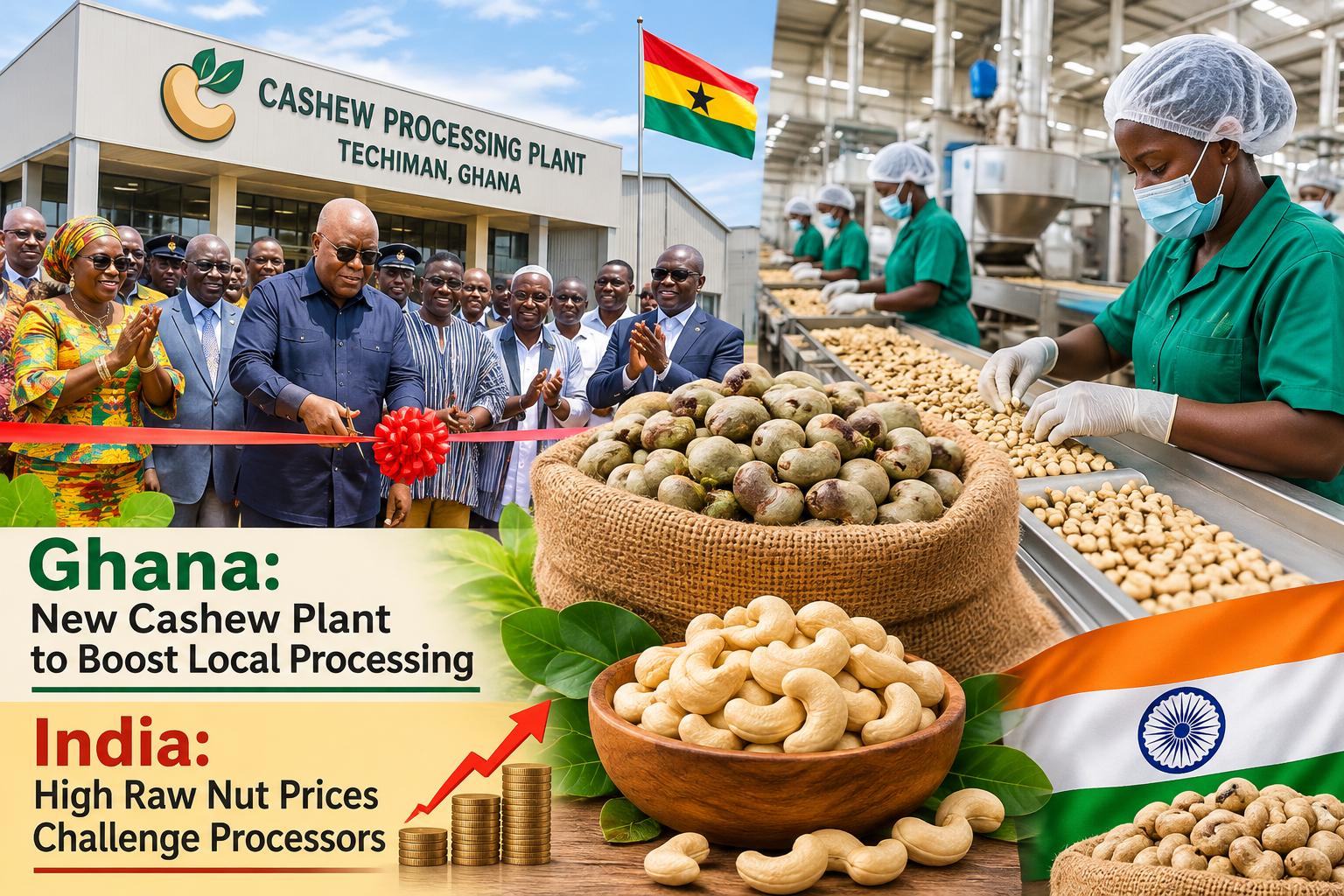
ACCRA, Ghana — Ghana is preparing to inaugurate a new cashew processing plant in Techiman, in the Bono East Region, as the country steps up efforts to increase domestic processing and capture more value from its cashew industry.
The facility, developed by Nadkansco Processing Limited with financing from the Ghana Export-Import Bank (GEXIM), is scheduled to be inaugurated by President John Dramani Mahama on November 16, 2026.
According to GEXIM, the plant will have the capacity to process 100 metric tonnes of raw cashew nuts (RCN) per day, equivalent to approximately 30,000 tonnes annually, assuming 300 operating days. The total investment cost has not yet been disclosed.
The new facility represents another step in Ghana's efforts to strengthen its domestic cashew-processing industry and reduce its dependence on exporting raw nuts.
Ghana Considers Restrictions on Raw Cashew Exports
Alongside expanding processing capacity, Ghana is preparing policy measures to prioritize domestic processors over international raw cashew buyers.
The government plans to temporarily restrict raw cashew exports during the first three months of each harvest season to ensure that local processing factories have sufficient supplies before exporters can ship nuts overseas.
Under the proposed arrangement, exporters would only be permitted to export raw cashews after domestic factories have secured adequate quantities for their processing requirements. The approach mirrors a policy adopted by Côte d'Ivoire, the world's largest raw cashew producer.
Ghana produced more than 262,000 tonnes of raw cashew nuts in 2025, but only a relatively small proportion was processed domestically, meaning that much of the value generated from processing continues to be captured overseas.
The government is also planning to introduce an export levy on raw cashew nuts. Revenue generated from the levy would be used to establish a fund supporting local processors in purchasing raw materials and expanding their businesses.
These measures reflect Ghana's ambition to move beyond raw-material exports and develop a stronger domestic processing industry.
India Faces Pressure From Rising Raw Cashew Prices
While West African producing countries are seeking to expand domestic processing, India's cashew industry is facing a different challenge: rising raw cashew nut prices and increasing processing costs.
Raw cashew prices approaching US$2,000 per metric tonne, combined with the US dollar reaching approximately 94 Indian rupees, are raising concerns about the economic sustainability of India's traditional processing business model.
For decades, India has developed one of the world's largest cashew-processing industries, supported by thousands of factories, millions of working hours and countless families whose livelihoods depend on the sector.
However, the combination of expensive raw materials and currency pressures is creating growing difficulties for processors.
The central question facing the Indian industry is no longer simply how high raw cashew prices might climb, but how long processors can absorb the additional costs while maintaining commercially viable operations.
When the cost of processing one kilogram of cashew kernels becomes increasingly difficult to justify, factories may face pressure on margins, working capital and purchasing decisions.
A Changing Global Cashew Industry
The developments in Ghana and India illustrate two interconnected challenges facing the global cashew industry.
Ghana is attempting to strengthen its domestic processing capacity through new factories, export restrictions and financial support for local processors. India, meanwhile, must navigate higher raw-material costs and currency movements that could affect the competitiveness of its established processing sector.
For Cambodia, these developments are particularly relevant.
Cambodia produced approximately 1.03 million tonnes of raw cashew nuts in 2025, making it one of the world's largest producers. However, domestic processing accounted for only around 26,000 tonnes, or approximately 2.6% of total production.
The experiences of Ghana and India offer important lessons for Cambodia. Expanding processing capacity requires not only factories and investment incentives, but also access to competitively priced raw materials, affordable financing, efficient infrastructure and sustainable business models.
Ultimately, the future of the global cashew industry will depend on how producing and processing countries balance farmers' interests, raw-material supply, industrial investment and international market competitiveness.
For Cambodia, the opportunity is to develop its domestic processing industry without undermining the competitive market that currently benefits its farmers.