CAC News
Accra, Ghana, May 2026 — Ghana’s cashew sector is attracting renewed attention from international buyers and investors as demand for premium, traceable cashew kernels continues to grow. However, industry experts say the country still faces significant challenges in capturing more value from its production due to limited domestic processing capacity and quality concerns.
Ghana is widely recognized for producing high-quality raw cashew nuts (RCN), which are sought after by buyers in Vietnam, India, and Europe. Despite this reputation, most of the country’s cashew harvest is exported in raw form, allowing processing, packaging, and branding profits to be captured abroad.
Industry observers note that demand for premium-grade W320 kernels among European specialty food buyers is increasing, particularly for products traceable to specific farming communities. This trend is encouraging buyers to seek closer relationships with producers at the origin rather than relying solely on traditional trading hubs.
The country’s major producing regions, including Bono, Bono East, Ahafo, and parts of Northern Ghana, possess strong production capacity and established farmer networks. However, stakeholders say the lack of large-scale processing infrastructure and export-ready packaging facilities continues to limit Ghana’s ability to move further up the value chain.
The implementation of the African Continental Free Trade Area (AfCFTA) is also expected to create new opportunities for value-added cashew products by facilitating trade in processed goods across Africa under preferential terms.
Experts Urge Realistic Expectations
Despite the optimism surrounding the sector, industry specialists caution that significant economic challenges remain.
Jim Fitzpatrick, a global cashew industry expert, noted that Ghana’s high farmgate prices, driven by strong nut quality and favorable harvest timing, often make local processing less profitable.
“The prices buyers are willing to pay for Ghanaian raw cashew nuts make it difficult for processors to compete profitably,” he said.
Jim added that while opportunities exist, investor confidence will depend on demonstrating clear advantages in cost, quality, and risk management rather than relying on concerns about a narrowing investment window.
He also pointed out that West Africa already has substantial unused processing capacity, with new factories continuing to be built and regional production still expanding.
Quality Concerns Remain
Vikash Kumar, a representative of an international trading company, highlighted ongoing concerns regarding quality consistency.
He said some processors in Vietnam and India have become increasingly cautious about sourcing from Ghana due to recurring issues related to drying standards and quality variations.
“Proper drying and quality assurance are essential to maintaining buyer confidence,” Kumar said, noting that improvements in post-harvest handling could strengthen Ghana’s competitiveness in international markets.
Cambodia Draws Lessons from Ghana
The developments in Ghana are also being closely monitored by other producing countries, including Cambodia.
Silot Uon, President of the Cashew Nut Association of Cambodia (CAC), said that a CAC representative, Mr. Suy Kokthean, visited Ghana in 2023 to study the country’s cashew industry and praised the progress Ghanaian stakeholders have made.
He noted, however, that the two countries possess different market strengths. While Ghana is well known for producing W320 kernels, Cambodia has a comparative advantage in larger premium grades such as W180 and W240.
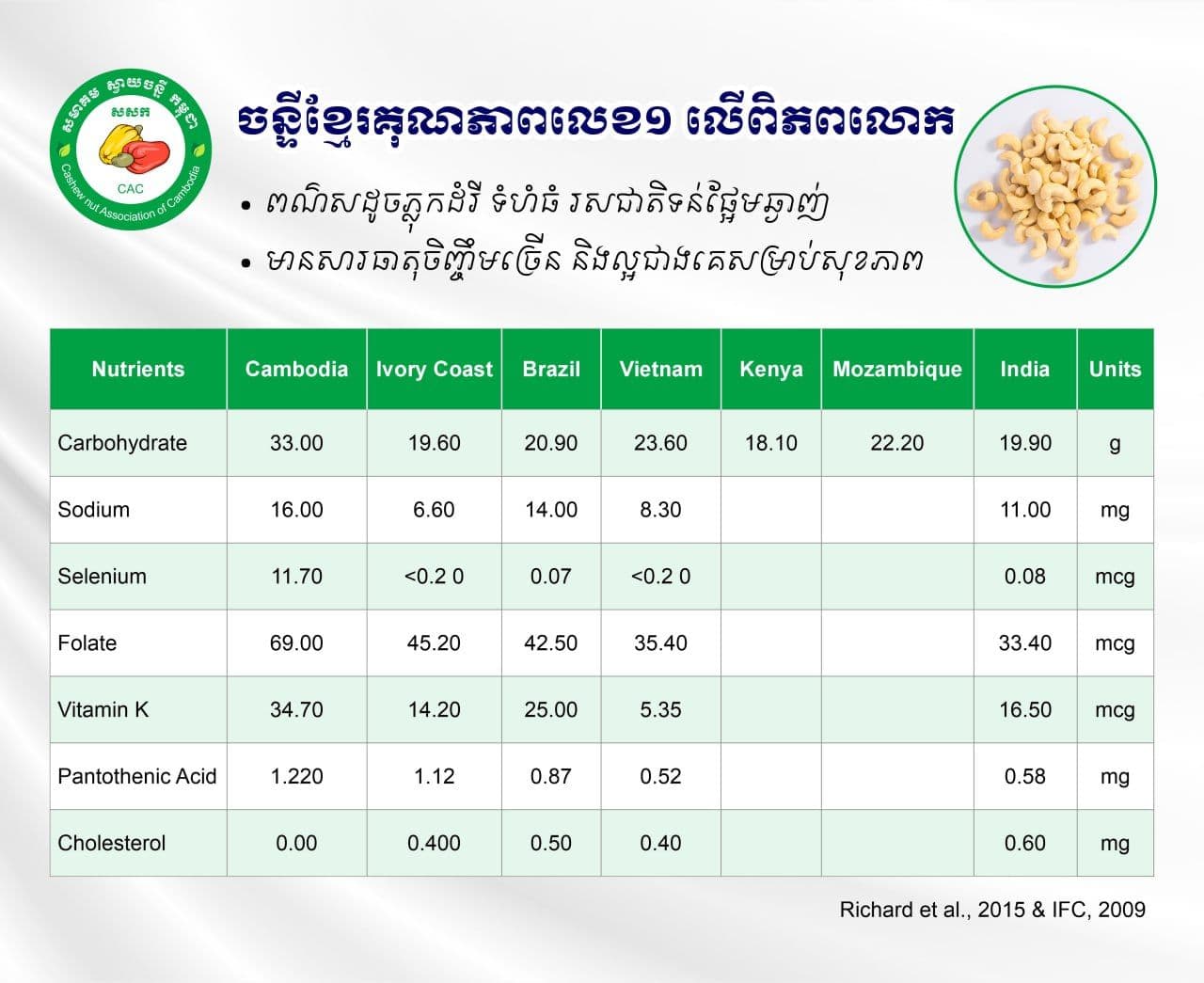
According to Silot, Cambodia’s M23 cashew variety has earned international recognition for its nutritional value and distinctive texture, with research assessments conducted by Japanese institutions highlighting its premium characteristics.
As global demand for traceable and high-quality cashew products continues to rise, both Ghana and Cambodia are seeking to expand domestic processing and strengthen their positions in the increasingly competitive international cashew market.