
India’s cashew industry, long regarded as a global processing powerhouse, is undergoing a significant transformation driven not by weak demand, but by mounting structural pressures across its supply chain.
Industry observers note that what once appeared to be a straightforward processing success story is increasingly evolving into a complex network management challenge, as rising costs, shifting logistics, and decentralised operations reshape the sector.
Heavy Reliance on Imported Raw Materials
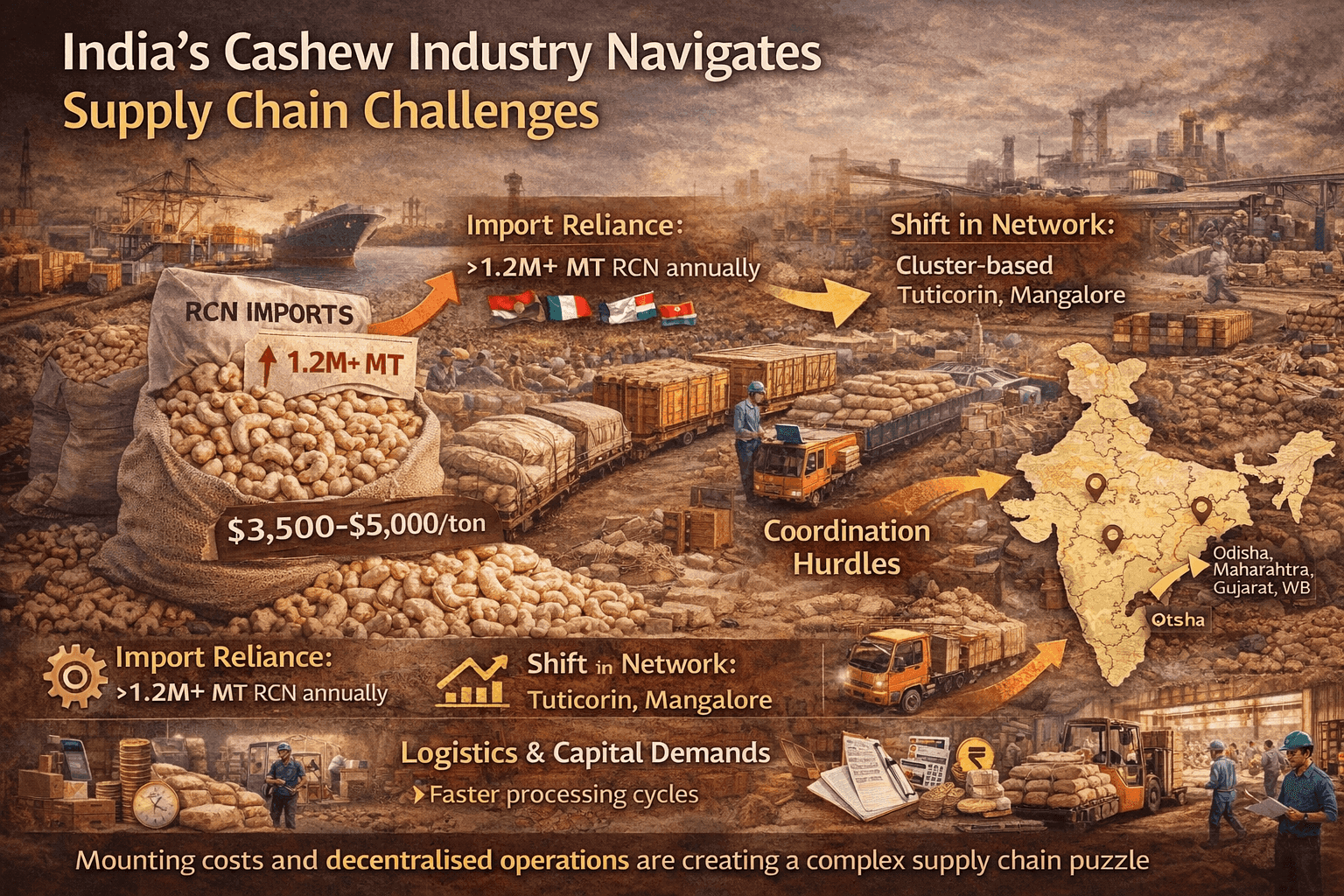
India continues to produce approximately 750,000 to 800,000 metric tonnes of raw cashew nuts (RCN) annually. However, domestic output is no longer sufficient to sustain its vast processing capacity.
Imports have surged beyond 1.2 million metric tonnes in recent years, compared to less than 1 million metric tonnes previously. This growing dependence on supplies from Africa and Southeast Asia has positioned India among the world’s largest RCN importers, increasing its exposure to global price volatility.
Margin Pressure Intensifies
At the same time, the industry is facing tightening margins. Import prices for raw cashew nuts have risen by an estimated 25–30% year-on-year in recent cycles, while kernel prices have experienced corrections after earlier peaks.
This imbalance has placed export competitiveness under strain, with processing spreads narrowing and profit margins quietly compressing across the sector.
Shift from Cluster-Based to Distributed Network
Over the past decade, India’s cashew industry has undergone a fundamental shift in its operational structure. Traditionally, processing was concentrated around key coastal hubs such as Tuticorin, Mangalore, Visakhapatnam and Kerala.
Today, processing activities have expanded inland to states including Odisha, Maharashtra, Gujarat and West Bengal. This transition has led to a more distributed network, with increased storage capacity and broader participation across regions.
As a result, efficiency is no longer defined solely by scale, but increasingly by the ability to coordinate across multiple nodes within a complex supply chain.
Decentralisation Brings Both Opportunities and Challenges
The decentralisation of processing has brought several advantages, including reduced dependence on a few major hubs, greater sourcing flexibility, and the development of new processing zones supported by expanding road and railway infrastructure.
However, it has also introduced new challenges. Fragmented inventories, higher coordination requirements, increased working capital demands, and pressure to maintain consistent quality standards are emerging concerns for industry players.
Logistics and Capital Efficiency Take Center Stage
With operations spread across multiple locations, logistics and working capital management have become critical determinants of profitability. Inefficiencies in inland transport, staggered processing schedules, and complex shipment documentation cycles have extended cash conversion timelines.
Industry analysts note that profitability is now increasingly driven by capital efficiency rather than traditional processing margins alone.
Traditional Hubs Retain Strategic Importance
Despite the decentralisation trend, traditional hubs such as Tuticorin and Mangalore continue to play a vital role. These locations remain key distribution centers, supported by strong trader networks and well-established supply chain linkages.
Their role has evolved from purely logistical hubs to strategic commercial control centers within the broader network.
Global Position Faces Growing Competition
India’s position in the global cashew industry is also under pressure, caught between African countries that control raw-material supply and Vietnam, known for its highly efficient, technology-driven processing sector.
In some clusters, more than 70% of processing depends on imported raw cashew nuts, further highlighting the sector’s vulnerability.
Labour Challenges and Need for Adaptation
The industry remains largely labour-intensive, with relatively low levels of automation compared to global competitors. Rising labour costs are adding to the pressure, making structural adaptation increasingly necessary to maintain competitiveness.
A Network-Driven Future
Experts emphasize that India’s future in the global cashew trade will not be defined by processing scale alone. Instead, success will depend on how effectively the industry manages its increasingly complex supply chain network.
As the sector navigates rising costs and structural shifts, coordination, efficiency, and strategic adaptation will be key to sustaining its global leadership.