
CAC News
Currency shocks, quality concerns, and logistics bottlenecks are testing the global cashew value chain, but industry stakeholders see the challenges as catalysts for the next phase of growth.
The global cashew market is navigating a complex landscape in 2026 as fluctuating currencies, quality-related challenges, and supply chain disruptions weigh on trade. Despite these headwinds, strong demand in key Asian markets and expanding processing capacity across producing countries continue to support long-term optimism.
India: Currency Pressure Meets Resilient Demand
In India, a weakening rupee has increased the cost of importing raw cashew nuts (RCN), placing additional pressure on processors. However, domestic kernel prices have remained firm, indicating stable demand and disciplined market pricing despite higher input costs.
West Africa: Quality Becomes a Competitive Advantage
Côte d’Ivoire, the world's largest producer of raw cashew nuts, is expected to harvest a crop slightly below last year's record level. At the same time, stricter port inspections are exposing quality shortcomings, leading to lower prices for substandard nuts. As a result, farmers and traders are increasingly focusing on quality improvement to remain competitive.
Nigeria: Logistics Take Center Stage
Nigeria's cashew production continues to grow, but exporters face persistent challenges from container shortages, port congestion, and shipping delays. Industry observers note that efficient logistics have become a critical competitive advantage, helping exporters secure better margins and strengthen relationships with international buyers.
Global Supply Expands as Processing Capacity Grows
Global raw cashew production is expected to remain near historic highs, supported by strong harvests across Africa and Asia. Africa is steadily emerging as a processing powerhouse, while Cambodia, India, and several African countries continue investing in domestic processing facilities.
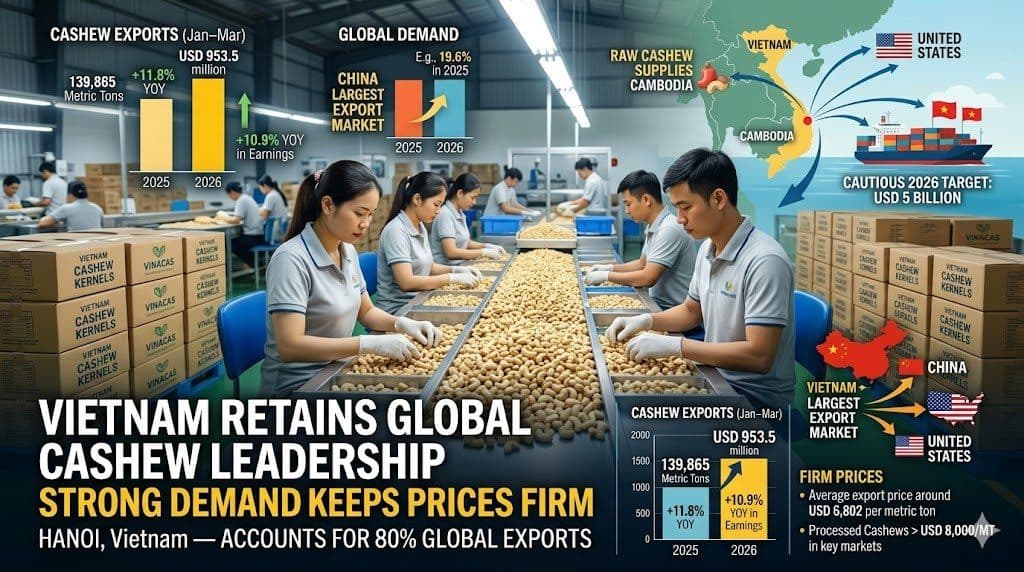
Vietnam remains the world's leading cashew processor and exporter, although the industry is increasingly focused on optimizing sourcing strategies and improving processing efficiency amid rising competition.
Cambodia continues to play a pivotal role in the global supply chain as a major supplier of raw cashew nuts to Vietnam's processing industry. However, the country is also seeking to expand its own processing capacity to capture greater value from production.
Demand Signals Mixed Across Global Markets
Global demand trends remain uneven. China, Japan, and several Middle Eastern markets continue to support buying activity, while demand from the United States and Europe has softened amid inflationary pressures and increased competition from lower-cost snack alternatives.
Domestic kernel demand remains relatively quiet, with limited new bookings reported across several markets. Meanwhile, lower-quality raw nuts and reduced outturn rates are constraining kernel availability and tightening supply in some export channels.
Trade Flows Reflect Shifting Market Dynamics
Asia continues to dominate global cashew trade, accounting for approximately 78% of total export volume. However, the region is also experiencing the greatest pressure, particularly from India, which remains the largest buyer but is reportedly importing significantly less than a year ago.
Europe has emerged as one of the brightest spots in the market. Import volumes increased sharply in May and are substantially higher year-to-date, led by stronger demand from the Netherlands and Germany. Although Europe represents a smaller share of global consumption, the growth trend has attracted industry attention.
The Americas have also shown signs of recovery. U.S. imports rebounded strongly in May following a subdued April, although cumulative import volumes remain below 2025 levels.
Outlook
Market participants expect volatility to persist in the coming months as geopolitical tensions, freight disruptions, and supply constraints continue to influence trade flows. Nevertheless, investments in processing capacity, quality improvement, and supply-chain efficiency are positioning the industry for future growth.
While 2026 presents significant challenges, industry leaders believe the sector's long-term fundamentals remain strong, supported by growing consumer awareness of cashews as a nutritious, plant-based food and continued demand from key markets across Asia and the Middle East.