
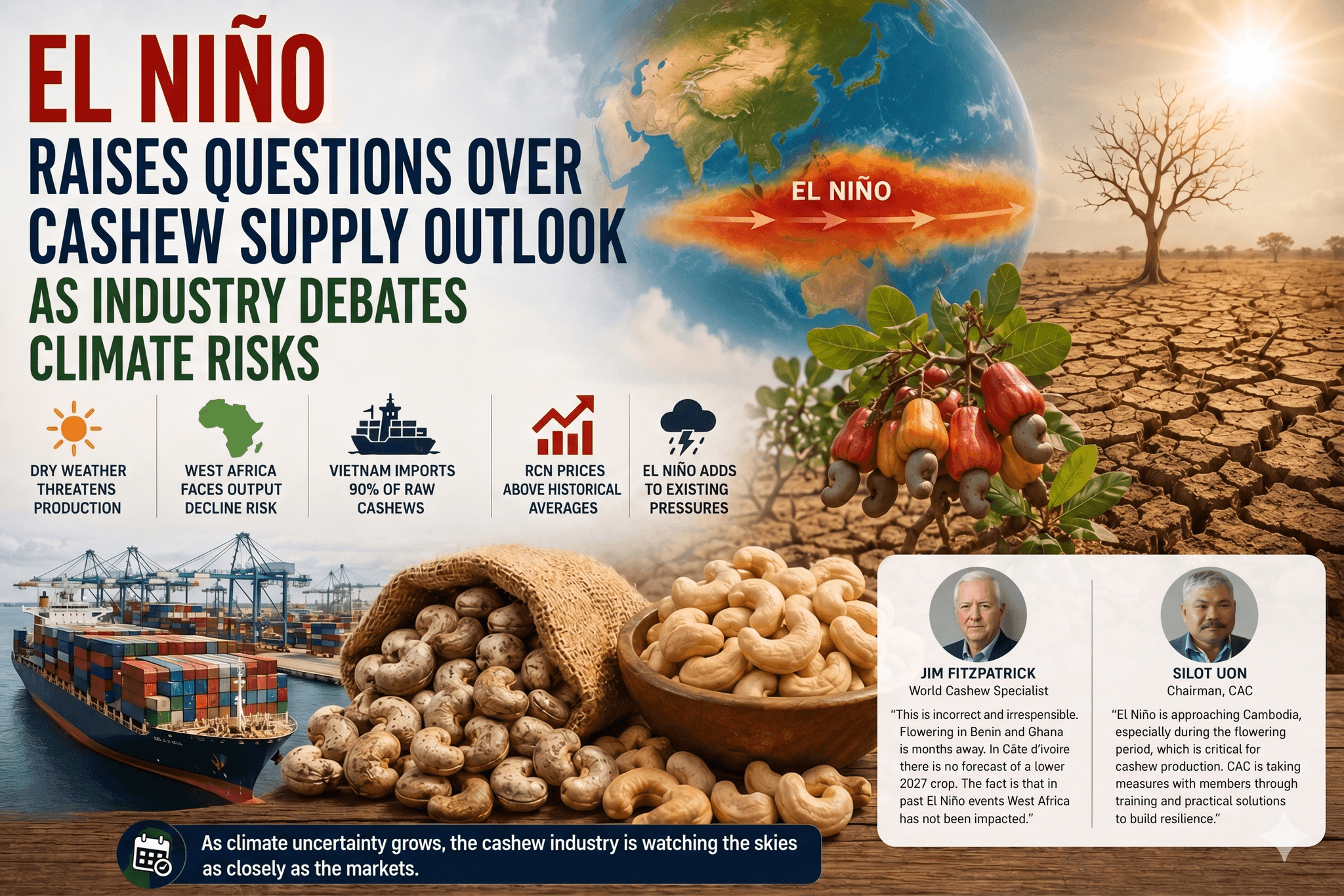
PHNOM PENH, Cambodia, Sept. 28, 2026 — The Cashew Nut Association of Cambodia (CAC) has urged cashew growers to strengthen crop management and secure adequate water supplies as rising temperatures and drought risks associated with the strengthening El Niño phenomenon could affect cashew production in 2027.
CAC President Mr. Silot Uon told AMS News that farmers have largely completed planting new cashew saplings, but warned that the expected hot and dry conditions could pose particular risks to newly established orchards.
The U.S. National Oceanic and Atmospheric Administration (NOAA) said in its September outlook that El Niño is strengthening, with more than a 90 percent chance of a very strong event during the Northern Hemisphere fall and winter of 2026–27.
According to Mr. Silot, prolonged heat and water shortages could place newly planted cashew trees under stress, potentially causing wilting, scorch damage and, in severe cases, tree mortality. Mature, fruit-bearing trees could also experience reduced yields and lower kernel quality if water availability becomes insufficient.
“We are concerned about the possible extent of the impact, although the exact scale remains uncertain,” Mr. Silot said, emphasizing the need for farmers to prepare early and strengthen their resilience to extreme weather.
He said water management would be particularly important during periods of high temperatures and limited rainfall. Newly planted saplings require sufficient moisture to establish their root systems, while mature trees also need adequate water to support flowering, fruit development and yield.
The CAC president noted that new cashew planting increased during this year's rainy season as farmers responded to more favorable market conditions compared with previous years. This expansion, however, makes early preparation for potential climate stress increasingly important.
Over the past four months, CAC has also conducted refresher training workshops in several provinces, including Kampong Thom, Kampong Chhnang, Kratie, Siem Reap, Preah Vihear and Ratanakiri, to help farmers adapt their production practices to hotter and more variable weather conditions.
Training has focused on practical measures including water management, crop care, pest and disease monitoring and other climate-resilient farming practices.
Despite the climate concerns, Mr. Silot said CAC remains optimistic about the outlook for Cambodian cashew prices.
He said tightening supplies in major producing countries could create continued demand for Cambodian raw cashew nuts. In particular, if West African producers reduce or suspend raw cashew nut sales to major processing markets such as India and Vietnam, buyers could increasingly look to Cambodia for supplies.
“Cambodia must therefore safeguard both yield and quality,” he said, noting that favorable market conditions would be more beneficial to farmers if production can be maintained despite climate pressures.
Cambodia's cashew sector recorded strong export performance in the first half of 2026. According to CAC unofficial data reported in August, the country exported approximately 1.08 million tonnes of raw cashew nuts during the first six months of the year, generating around US$1.8 billion in revenue, an increase of 29 percent compared with the same period in 2025.
With the possibility of severe climate conditions coinciding with the development of the 2027 crop, CAC is encouraging farmers to prioritize water conservation, orchard management and timely crop protection measures to reduce potential losses.
The association said continued farmer training and early preparation will be important to maintain Cambodia's cashew productivity and quality while responding to increasingly challenging weather conditions.
Reference: AMS News